
Our history: tradition meets logistics expertise
Behind TERRATRANS lies a success story spanning more than 50 years – shaped by Hanseatic reliability, continuous expansion and a firm commitment to always finding the best transport and logistics solution for our customers. Steady through every economic cycle: from the first oil crisis through the 2008/09 financial crisis and the coronavirus pandemic to the supply-chain and energy crises of recent years, we have developed step by step – through strategic investment in rail, road and logistics infrastructure – into an internationally operating logistics expert.
50 years of TERRATRANS at a glance
- The 1970s – the founding years
- 1974
Founded by Peter Prinz and Rainer Wenneker in a two-room flat in Bremen-Neustadt
- 1975
First branch in Concorezzo (Italy); early entry into Portugal
- 1977
Opening of the Hamburg site
- 1978
Move to Flughafendamm; first own warehouse (300 m²) and first own lorry
- The 1980s – own fleet & freight village
- 1987
First long-distance haulage licence from the City of Bremen – launch of the own lorry fleet
- 1989
Move to the Bremen freight village (GVZ) with a rail siding
- The 1990s – growth & Asia
- 1994
Expansion in the freight village: multi-user warehouse at Ludwig-Erhard-Straße 40
- 1997
Exclusive general agency for Far East Cargo Line in Germany
- The 2000s – rail & headquarters
- 2002
Launch of combined transport by rail: Bremen–Verona
- 2007/08
Takeover of the complete Bremen–Verona block train; operated as our own train from 01/01/2008
- 2008
New administrative building at Ludwig-Erhard-Straße 40 A; Hamburg relocates to Allermöhe
- 2009
Verona branch (Italy–France traffic); fleet modernisation to Euro 5
- The 2010s – expansion & awards
- 2010
New site in Lemgo (East Westphalia)
- 2011
Combined transport expanded to eight block trains per week Bremen–Verona
- 2013
New logistics facility at Erich-Kühlmann-Straße (6,000 m²) for tiles, DIY stores & specialist retail
- 2016
"Golden Transport Partner 2016"; warehouse lighting converted to LED; daily departures to Italy
- 2017
Joined the Centrolene network – in addition to Far East Cargo Line
- 2018
Hamburg branch relocates to Wilhelm-Iwan-Ring
- The 2020s – crisis-proof & climate-friendly
- 2020
Foundation of TERRATRANS Italia Srl.; warehouses converted to electric forklift trucks
- 2021
Turkey traffic +40%; first LNG lorries; over 17,000 t of CO₂ saved
- 2022
Record of 20,950 t of CO₂ saved; fleet expanded by 60 semi-trailers
- 2024
New generation of management: Stefan Prinz and Arne Müller; 18,650 t of CO₂ saved
- 2025
Integration of Riehl Logistik GmbH into TERRATRANS
1974–1979
The founding years: from Bremen's Neustadt to Flughafendamm
On 01/01/1974, Peter Prinz and Rainer Wenneker founded TERRATRANS – then still HB TERRATRANS – in a two-room flat in Bremen-Neustadt. The name, formed from "Terra"cotta and "Trans"port, reflects our deep roots in the import of Italian tiles. As early as 1975, the team expanded to Concorezzo (Italy) and, shortly after the revolution, became one of the first freight forwarders active in Portugal. After the Hamburg office opened (1977), the Bremen team moved to Flughafendamm in 1978, where a 300 m² warehouse and the first own lorry laid the foundation for the company's own fleet. The team quickly grew to 35 people.


1980–1989
Major fire, first long-distance haulage licence & move into the freight village
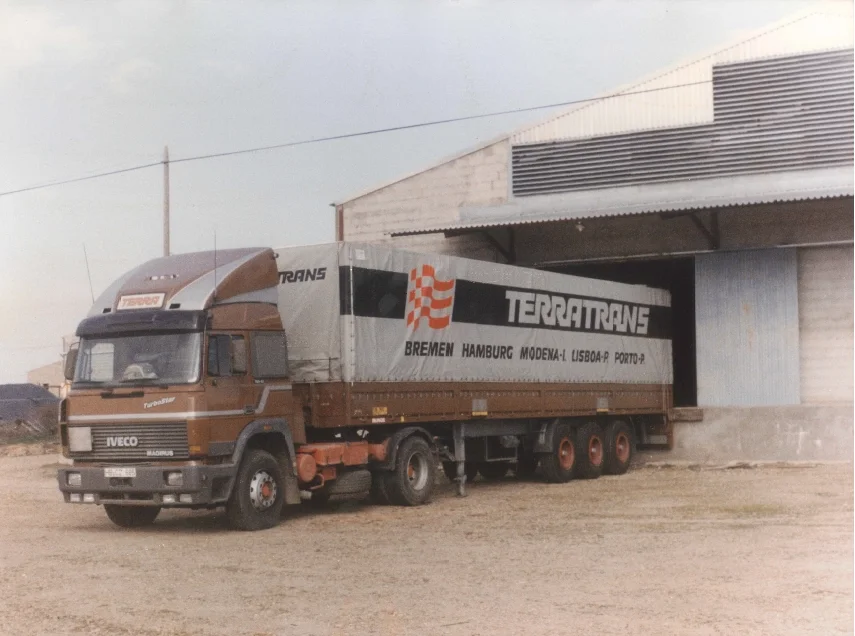
The year 1981 brought severe setbacks: a major fire completely destroyed the premises at Flughafendamm – yet operations continued under the most adverse conditions, and the facility was rebuilt immediately. In the mid-1980s, the successful in-house training programme for logistics professions was also launched. In 1987, TERRATRANS received its first official long-distance haulage licence from the City of Bremen to build up its own lorry fleet. A historic milestone followed on 01/12/1989: the strategic move into the newly created Bremen freight village (GVZ) – a modern, 10,000 m² facility with a direct rail siding at Ludwig-Erhard-Straße 14.


1990–1999
Site expansion & the partnership with Asia
Driven by dynamic business growth, TERRATRANS expanded within the Bremen freight village in 1994 and built a large multi-user warehouse at Ludwig-Erhard-Straße 40 with 6,500 m² of warehouse space plus additional offices. The international breakthrough in the overseas segment came in 1997: TERRATRANS took over the exclusive general agency for Far East Cargo Line in Germany, opening up direct, exclusive access to one of the most powerful logistics networks between Asia and Europe. By its 25th anniversary on 01/01/1999, the company already employed 140 people.


2000–2009
The rail bridge to Italy, a new headquarters & proving ground in the crisis
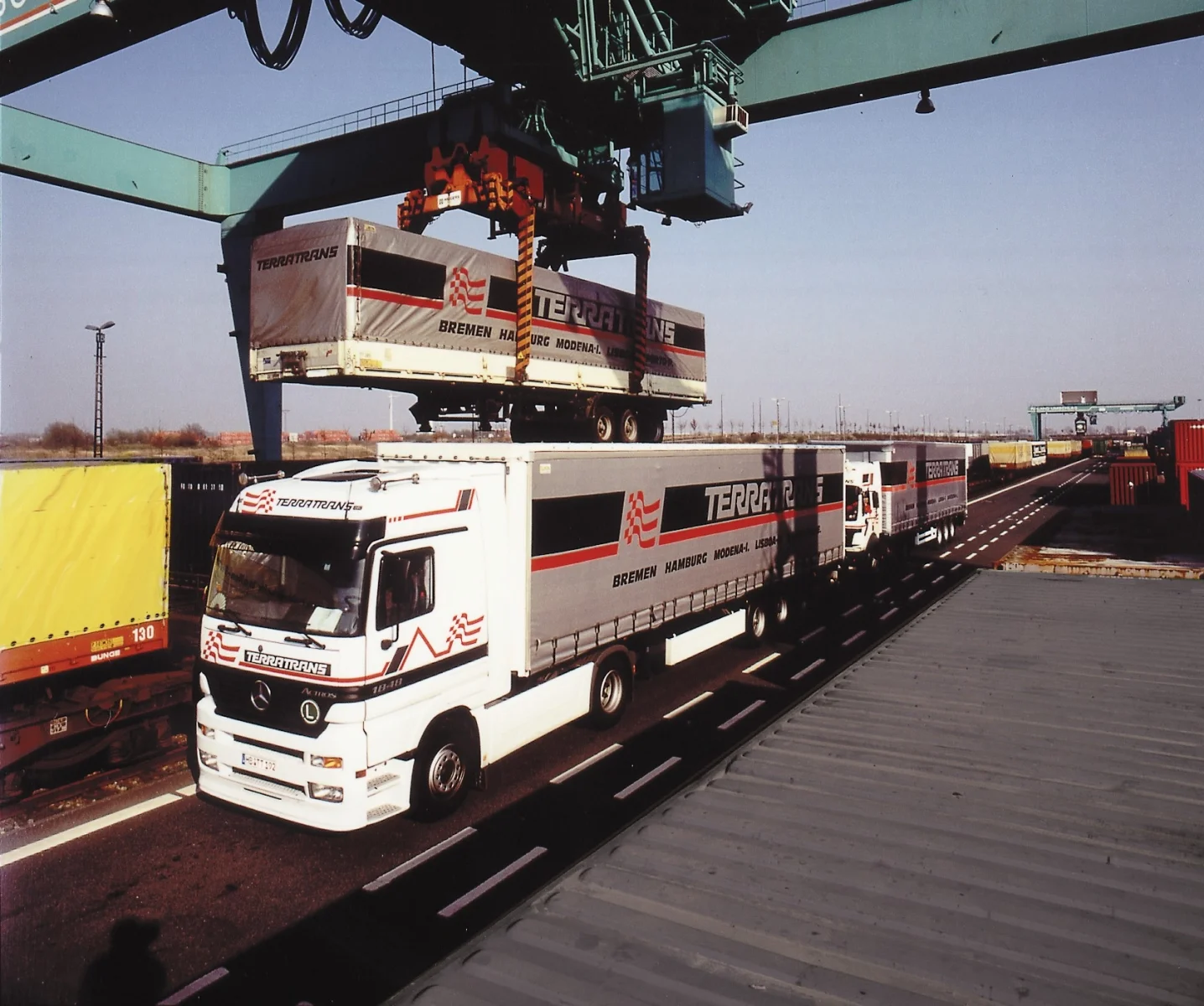
In 2002, TERRATRANS launched its environmentally friendly combined-transport solution between Bremen and Verona, shifting traffic from road to rail. During the global logistics boom of 2005 to 2007, the company grew strongly: the workforce rose from 126 (2005) through 168 (2007) to around 196 (2009), additional handling and storage space was added in the freight village, and in 2005 the logistics facility at Ludwig-Erhard-Straße 10 was acquired. A strategic step for our Italy expertise: in 2007/2008, together with a partner, TERRATRANS took over the complete Bremen–Verona block train and operated it as its own train from 01/01/2008, initially with six departures per week. In 2008, the new administrative building at Ludwig-Erhard-Straße 40 A was occupied and the usable floor space at the site was expanded to around 45,000 m²; the Hamburg branch moved to Allermöhe.
When the global financial crisis hit the logistics industry with full force in 2008/2009 – container volumes fell by up to 25% across the industry and tens of thousands of lorries were taken off the road in Germany – TERRATRANS held its course: the warehouses remained at capacity, the Italy block train continued to run fully loaded, and in September 2009 a branch was opened in Verona for Italy–France traffic. At the same time, the systematic modernisation of the fleet from Euro class 3 to Euro 5 began.

2010–2019
Expansion in East Westphalia, Hamburg and Bremen, awards & energy efficiency
In 2010, the East Westphalian branch moved into its current, larger logistics site in Lemgo. Combined transport to Italy was expanded further: from mid-2011, eight complete block trains ran per week on the Bremen–Verona route, with a ninth departure added temporarily at peak times – underpinned by investment in additional trailers and swap bodies. At the Bremen headquarters, the summer of 2013 saw the construction of a state-of-the-art, 6,000 m² logistics facility at Erich-Kühlmann-Straße – for special goods such as tiles and products for supplying DIY stores and specialist retail. The workforce reached a peak of around 220 during these years.
In 2016 – the weakest year for world trade since 2009 and in the midst of the sea-freight crisis – TERRATRANS held its ground impressively: the Hamburg route was switched to daily departures, 75% of a beverage-industry customer's Europe-wide tendered Italy volume was won again, and the company was awarded the title "Golden Transport Partner 2016" for the best transport service within Europe. For a DIY customer, TERRATRANS took on the role of a cross-docking centre for Scandinavia. In terms of environmental protection, the entire Bremen warehouse lighting was converted to LED and energy costs were significantly reduced. At the end of 2016, joining the Centrolene network – complementing Far East Cargo Line – extended the company's global reach. To close the decade, the Hamburg team moved to Wilhelm-Iwan-Ring in 2018.


2020–2025
Crisis-proof, climate-friendly & a new management team
Despite the COVID-19 crisis, TERRATRANS continued to expand in 2020 and founded TERRATRANS Italia Srl. In a year in which world trade slumped by around 12% in the second quarter and Italy and Spain in particular were hit especially hard, the warehouses remained at capacity; after a brief suspension in the first quarter, all eight block trains were running again from the second quarter, and the warehouses were fully converted to electric forklift trucks. In 2021 – the year of the "Ever Given" and disrupted supply chains – 40% growth in Turkey traffic offset the declines from the Far East; more than 17,000 tonnes of CO₂ were saved through combined transport to Italy, and the first two lorries with LNG gas propulsion joined the fleet.
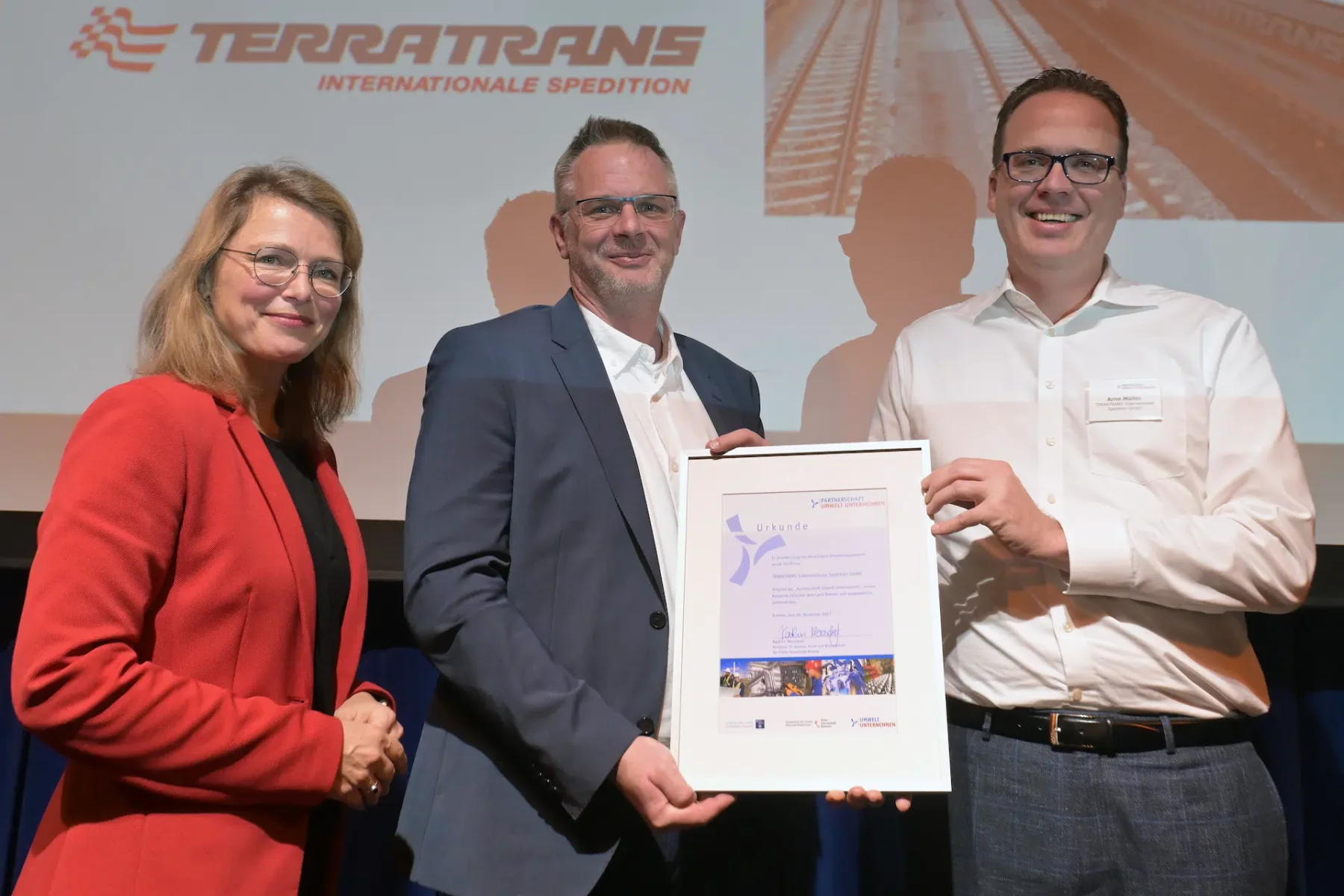
In 2022 – amid the war in Ukraine and the energy crisis – the high utilisation of the Company Train increased CO₂ savings to a record 20,950 tonnes; at the same time, TERRATRANS expanded its own fleet by 60 new semi-trailers. In March 2023, we once again received the "Certificate of Recognition" (1st place) from a major customer and partner in the beverage industry. At the end of 2023, the long-serving directors Rainer Wenneker and Siegfried Stengert retired from operational duties as planned; on 01/01/2024, the new generation of management, Stefan Prinz and Arne Müller, took over official leadership. In 2024 – a historically weak year for world trade – TERRATRANS made the Company Train departures more flexible as required, saved a further 18,650 tonnes of CO₂ and invested in 50 new semi-trailers. This repositioning is rounded off by the full integration of Riehl Logistik GmbH into TERRATRANS in 2025.
Looking ahead: with rising demand for more climate-friendly transport, our daily rail connections to and from Italy and a consistently modern own fleet, TERRATRANS sees itself well positioned for sustainable, moderate growth – steady, collaborative, Hanseatic.



Our development in figures
From the founding team of the first hour to around 180 employees today at five sites in Germany and Italy.
Launched in 2002, eight block trains per week Bremen–Verona from 2011, today with daily departures.
over 17,000 t (2021) · 20,950 t (2022) · 18,650 t (2024) – saved year after year through combined transport.
from the first 300 m² warehouse (1978) to around 60,000 m² of own warehouse space today in Bremen and Hamburg.
consistently Euro 6, first lorries with LNG propulsion, electric forklift trucks in all warehouses.